
June 2, 2026
A Brief History of the Native American Flute
By Mike Fifield
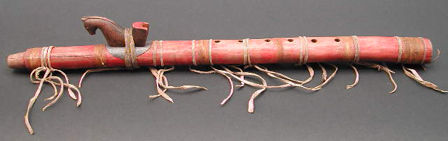
The first time I tried to figure out where the flutes I make come from, I went looking for one straight answer and didn't find it. The instrument we now call the Native American flute has the kind of history you piece together from museum bones, a few handwritten field notes, and a thin run of wax cylinder recordings made in the 1890s. What you end up with is something stranger and more moving than a clean origin story. Here is the short version.
The world had flutes long before it had us
The oldest flute we know of was carved from the wing bone of a griffon vulture about 40,000 years ago. It was found in a cave called Hohle Fels in southern Germany. Picture a hollow bone the size of a long pen, five finger holes drilled along it, beveled at one end so the player blew across the rim. It still works. Researchers have made replicas and gotten music out of them.
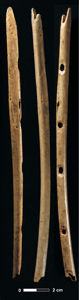
Bones make good flutes. Mammoth ivory does too. Most of the oldest flutes we have found were rim-blown — meaning you had to shape your lips to a precise angle to make a sound, the way a beginner struggles with a recorder mouthpiece. Skilled players sound beautiful; everyone else sounds like wind through a chimney.
At a site in central China called Jiahu, archaeologists found about thirty flutes made from the wing bones of red-crowned cranes. One of them, from a grave dated to 5,750 BCE, is the oldest intact, playable flute we have with a clearly determinable scale. You can hear recordings of musicologists playing it. The notes are recognizable. Almost 8,000 years ago, someone sat down and pierced finger holes in a bird bone and played music.

In North America, the oldest flute fragments we have are about 1,400 years old, from a place called Broken Flute Cave in northeast Arizona. Same idea — bone, rim-blown, hard to play. There is also a bone flute from East Texas, possibly 6,000 years old, that may have been side-blown instead.
The duct flute changes the game
Somewhere along the way, a maker had an idea: build the embouchure into the instrument itself. Carve a narrow channel that directs the player's breath at a precise angle onto a sharpened edge. Now the flute does the hard work. Anyone can pick it up and produce a clean tone.
That is called a duct flute. The recorder is one. The penny whistle is one. The Native American flute is one.
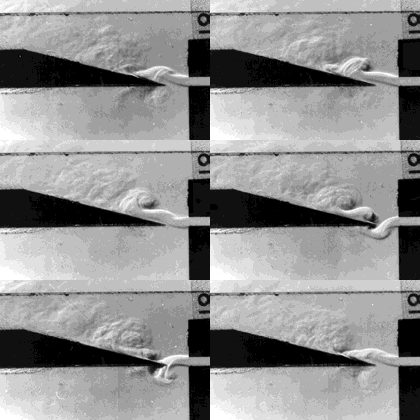
The earliest duct flutes we have are clay ocarinas from the Maya culture, made between 800 and 500 BCE. Mexico's Colima culture made duct flutes a few hundred years later. By the time Europe figured this out with the medieval recorder around 1350 CE, indigenous American makers had been playing duct flutes for two thousand years.
The Native American flute takes the duct flute and adds three things that are not in the recorder. There is a slow-air chamber — a sealed pocket behind your mouth that calms the breath before it hits the playing chamber. There is a mouth hole sized independently of everything else, so you can dial in tone. And there is a removable block tied to the outside of the flute that defines the duct itself. Loosen the block, slide it over, and the flute's voice changes.
The two oldest flutes we still have
In 1823, an Italian explorer named Giacomo Costantino Beltrami was wandering through what is now Minnesota, looking for the source of the Mississippi. He did not find it (he was off by a few hundred miles), but he came back with a wooden flute he had been given by Ojibwa people he met along the way. That flute is now in a museum in Bergamo, Italy. It is the oldest existing Native American flute we know of.

The second oldest is the Hutter Winnebago Flute, collected around 1825. They look similar — long, slender, with a carved block. They do not tell us much about where the design came from. By the time any outsider got around to writing things down, the NAF was already a fully formed tradition.
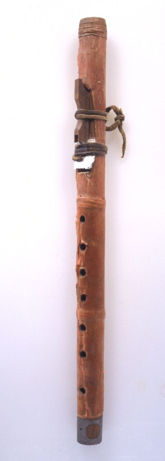
In 1856, a U.S. Army lieutenant named Sylvester Mowry was stationed along the Colorado River. He wrote in his notes about young men of the Yuma and Mohave tribes playing reed flutes as a kind of love language: "A young buck will play all day long to his sweet-heart, no words passing, save those conveyed by his flute." It is one of the earliest first-person descriptions we have of how the flute was actually used.
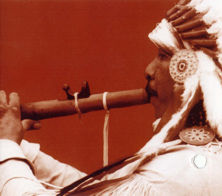
By the 1880s, Sioux makers were producing flutes with a now-iconic style: two flat birds carved at the block end, often inlaid with brass tacks. If you have seen a Native American flute in a photograph, there is a good chance it was this style or a descendant of it.

Something close to extinction
In the last decade of the 19th century, the U.S. government turned hard on Native cultural expression. The Sun Dance was banned. So were the potlatch and most forms of ceremony. Boarding schools removed children from their families and forbade them from speaking their languages or making their music. Federal policy through the 1940s was overtly aimed at assimilation, which is to say: the deliberate ending of cultures.
The flute did not survive everywhere. Many songs were forgotten. Many makers stopped making. By the mid-20th century, the Native American flute as a living tradition was hanging by a thread.
R. Carlos Nakai, a Navajo-Ute player whose recordings would later sell millions, put it this way: "When our amerind world 'turned upside down'… many songs, stories, and family histories… were cast aside or forgotten."
Belo Cozad and the wax cylinders
In 1941, a Kiowa flute player named Belo Cozad sat down in front of a recording device at the Library of Congress and played. He was 87 years old. He had learned from elders who came up before the suppression, and he carried songs nobody else could play.
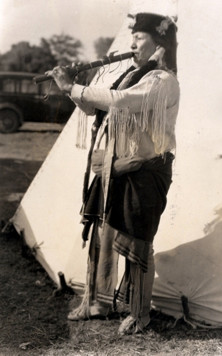
Those recordings still exist. They are part of the Library of Congress's Archive of Folk Culture. They are not the first ethnographic flute recordings — that distinction goes to Jesse Walter Fewkes, who in 1890 used Thomas Edison's wax cylinder phonograph to capture a Passamaquoddy song from a singer named Newell Joseph. Across multiple archives — Berkeley, Berlin, Indiana, the Library of Congress — there are roughly 20,000 wax cylinder recordings of Native American music. The Belo Cozad cylinders are some of the most important for the flute specifically.
If the lineage survived, it survived through people like him.
The man who saved it
A Kentucky-born doctor named Richard W. Payne spent much of his life traveling Central and South America for the U.S. Armed Forces in the 1940s and 50s. Indigenous music caught him early and never let go. When he got home, he started collecting flutes. By the time he died, he had the largest private collection of indigenous American flutes in the world.
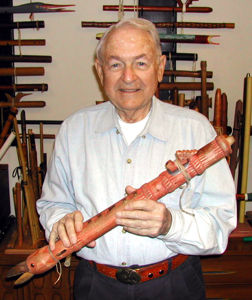
But he did not just collect. He learned to play, mostly from a Kiowa elder named Abel Big Bow who gave him the Kiowa name Toubat — "wind instrument." He studied with Richard Foolbull. He read everything the ethnomusicologist Frances Densmore had ever written. And then he started making flutes himself, in the traditional Plains styles, and giving them away.
Here is the part that matters. By the 1960s and 70s, the people Doc Payne knew on Native reservations no longer had elders who remembered how to make these instruments. The chain had broken. Doc Payne went around handing his hand-built replicas back to the communities they came from. He gave a flute to a Comanche painter named Doc Tate Nevaquaya in 1967, trading it for a painting. Nevaquaya became one of the most important players of the next generation. He gave another to a maker named O. W. Jones, who passed one of his flutes to R. Carlos Nakai, who would go on to become the most recorded Native American flute player of all time.
A working musical instrument almost disappeared, and a doctor with a hobby brought it back.
What you are holding today
The contemporary Native American flute owes its visual shape and tuning to a 1980s collaboration between Doc Payne and a maker named Michael Graham Allen, who played the Japanese shakuhachi and knew the pentatonic minor scale from that tradition. They settled on a five-hole layout in pentatonic minor. That is the design most makers, including me, use as a starting point today.
The pentatonic minor is what makes the flute so forgiving. Every note in the scale sits inside the chord your breath is establishing. You cannot play a wrong note. Beginners pick up a NAF for the first time and produce music almost immediately. That accessibility is intentional. It is the whole reason the renaissance happened.
R. Carlos Nakai released his first album in 1983. He has now recorded over fifty. The instrument has been used in soundtracks and Grammy-nominated records, in sound baths and meditation rooms and beginners' bedrooms.
I make flutes on a 3D printer. The materials are different from what Belo Cozad would have used. But the geometry — the slow-air chamber, the duct cut just so, the splitting edge, the six finger holes spaced by ear and intuition — comes from people I will never meet, and from people whose names we do not know. That is the part I keep thinking about while I print and tune each one.